
Federated Learning Explained: The Essential Guide to Collaborative AI
· VPNSoEasy Staff
Imagine improving an AI model with data from millions of phones or dozens of hospitals, without collecting that data in one place. That is the idea behind federated learning, and it is changing how privacy-minded teams build machine learning systems.
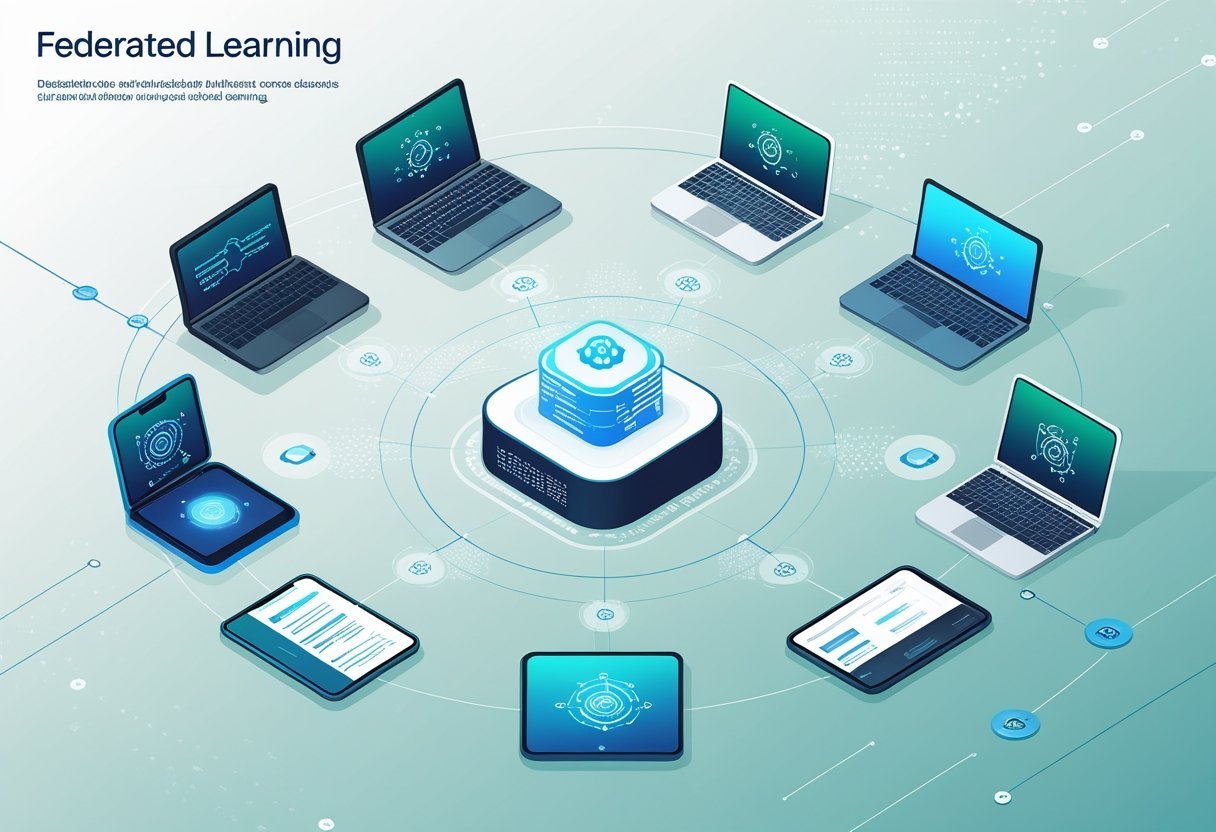
Federated learning is a way to train one shared machine learning model across many devices or organizations while each participant keeps its raw data local. Each participant trains the model on its own data and sends back only the resulting model update. A coordinating server combines those updates into a better global model and sends it out for the next round. Google researchers introduced the term and its core algorithm in a paper on communication-efficient learning from decentralized data, first posted in 2016.
The approach goes after one of the hardest problems in AI: getting enough good training data without moving sensitive records around. Hospitals can work on shared diagnostic models without pooling patient files. Phones can improve keyboard suggestions without uploading what you type. Federated learning reduces how much personal data travels, but it is not a privacy guarantee by itself, and this guide covers both sides.
Key Takeaways
- Federated learning trains a shared model while raw data stays on each device or server.
- Only model updates travel, and those updates can still leak information unless extra protections are added.
- Secure aggregation and differential privacy are the main add-ons that make federated learning meaningfully private.
- Real uses include mobile keyboards, hospital research networks, and fraud detection, with clear costs in complexity and communication.
What Is Federated Learning?
In traditional machine learning, you move the data to the model. In federated learning, you move the model to the data. The training happens where the data already lives, and only what the model learned is sent back.
Definition and Core Principles
Federated learning rests on two ideas. First, each participant, called a client, trains the current model on its own local data. Second, clients share model updates, such as changed weights or gradients, instead of the data itself.
A server coordinates the process. It decides which clients take part in each round, collects their updates, and combines them. Over many rounds the shared model learns patterns from everyone’s data, even though no single party ever holds all of it.
Federated Learning vs. Centralized Machine Learning
Centralized machine learning copies all training data to one location, usually a data center or cloud bucket. That is simple to build, but it creates a large, valuable target and puts the data under someone else’s control.
Federated learning keeps the data spread out. The comparison below shows the practical differences.
| Aspect | Centralized machine learning | Federated learning |
|---|---|---|
| Where training data lives | Copied to one server or cloud | Stays on each device or organization |
| What travels over the network | Raw data | Model updates |
| Main privacy risk | A breach or misuse of the central dataset | Information leaking through model updates |
| Main engineering cost | Storing and securing the dataset | Coordinating many clients over slower links |
The federated approach fits especially well where data is sensitive, regulated, or simply too large to move, such as personal phones and hospital records.
Main Components: Clients, Server, and Aggregation
Clients are the devices or organizations that hold data and do local training. In mobile systems a client is a phone. In business settings it might be a hospital, a bank, or a factory.
The server runs the process. It sends out the current global model, selects which clients join each round, and performs aggregation, the step that merges client updates into a new global model. In most systems the aggregator is part of the server, not a separate machine.
The cycle repeats until the model is good enough. Each round usually involves only a sample of clients, because in large fleets many devices are offline, busy, or low on battery at any given moment.
How Federated Learning Works
Federated learning runs as repeated training rounds. Each round has the same four steps, and the global model improves a little each time.
Step 1: The Server Prepares and Sends the Global Model
Training starts with an initial global model, often pretrained on public data. The server picks a group of eligible clients and sends each one the current model.
On phones, eligibility rules are strict. Google’s keyboard research, for example, describes devices that train only when they are idle, charging, and on an unmetered Wi-Fi connection, so training does not drain your battery or data plan (Hard et al., 2018).
Step 2: Each Client Trains Locally
Each client trains the model on its own data for a few passes and calculates how the model’s weights should change. The raw data never leaves the client.
Most federated learning today uses neural networks trained with gradient descent. Some frameworks also support tree-based models such as gradient-boosted trees, mainly for cross-organization projects.
Step 3: Clients Send Back Model Updates
When local training finishes, the client sends its model update to the server. Updates can be compressed to save bandwidth, and in well-designed systems they are also encrypted in transit and protected with secure aggregation, covered below.
Updates are usually far smaller than the raw data behind them, but a large model’s update can still be many megabytes. Communication cost is one of the main bottlenecks in federated systems.
Step 4: The Server Aggregates and Repeats
The server combines the updates into a new global model. The classic method is Federated Averaging, or FedAvg, which averages client updates and gives more weight to clients that trained on more examples.
The new model goes out in the next round. Training stops when accuracy levels off or a set number of rounds is reached.
Handling Non-IID Data
In a lab, training data is often shuffled so every batch looks similar. In federated learning it is not. One person types mostly in Spanish, another in English. One hospital sees mostly older patients. This uneven spread is called non-IID data, short for not independent and identically distributed.
Non-IID data can slow training and make the global model work poorly for some clients. Common responses include:
- Algorithms such as FedProx that keep local training from drifting too far from the global model.
- Personalization, where each client fine-tunes part of the model for its own data.
- Clustering clients with similar data and training a model per cluster.
- Adding a small shared public dataset to balance training.
Types of Federated Learning
Federated learning is usually grouped by how the data is split between participants. A widely cited taxonomy from Yang and colleagues names three types: horizontal, vertical, and federated transfer learning.
Horizontal Federated Learning
Horizontal federated learning applies when participants collect the same kinds of data about different people. Two regional banks with the same customer fields, or millions of phones running the same keyboard app, are horizontal setups.
This is the most common type. Phone keyboards that improve their next-word suggestions are the textbook example of cross-device horizontal federated learning.
Vertical Federated Learning
Vertical federated learning applies when participants hold different kinds of data about the same people. A bank and an online retailer in the same city might share many customers, with the bank holding payment history and the retailer holding purchase behavior.
The parties first find their overlapping customers using privacy-preserving matching, such as private set intersection, so neither side learns about the other’s non-shared customers. They then train a joint model with cryptographic protocols so neither reveals its own features. Vertical setups are almost always cross-silo, meaning a small number of organizations rather than millions of devices.
Federated Transfer Learning
Federated transfer learning applies when participants share few customers and few data fields. A bank in one country and an e-commerce company in another might have almost no overlap at all.
Transfer learning lets knowledge learned in one setting help in another, so the parties can still build a useful model despite the small overlap. It is the least mature of the three types and is mostly found in research and specialized enterprise projects.
Cross-Device vs. Cross-Silo
Cross-device federated learning involves huge numbers of unreliable clients, such as phones and IoT devices, each holding a small amount of data. Cross-silo federated learning involves a few reliable participants, such as hospitals or banks, each holding a lot of data. The engineering problems differ: cross-device systems fight dropouts and bandwidth, while cross-silo systems deal more with legal agreements and data alignment.
Centralized vs. Decentralized Coordination
Most federated learning uses a central server to coordinate rounds. That makes the system easier to run, but the server becomes a single point of failure and a party everyone has to trust to some degree.
Decentralized, or peer-to-peer, federated learning removes the server. Clients exchange updates directly with neighbors. That spreads trust around, but it is harder to run and to secure, and it remains mostly a research area.
Is Federated Learning Private? Security and Compliance

Federated learning keeps raw data local, which is a real privacy improvement. It does not make a system private on its own. Model updates are calculated from your data, and researchers have shown that updates can sometimes be used to reconstruct training examples or tell whether a specific record was used (Zhu et al., Deep Leakage from Gradients). Strong systems add the protections below.
Secure Aggregation
Secure aggregation is a cryptographic protocol that lets the server learn only the combined sum of many clients’ updates, not any single client’s update. Google’s widely used design has clients add random masks that cancel out when updates are summed, with secret sharing so the protocol still works when some phones drop out mid-round (Bonawitz et al., 2017).
Secure aggregation protects individual updates from the server, but it does not stop a malicious client from sending a poisoned update. Defending against that needs separate techniques, such as robust aggregation rules that limit the influence of outliers.
Differential Privacy
Differential privacy limits how much any one person’s data can affect the trained model. In federated learning this usually means clipping each update to a maximum size and adding carefully calibrated random noise, either on the device or during aggregation.
The strength of the guarantee is set by a privacy budget, often called epsilon. A smaller epsilon means stronger privacy but usually lower accuracy, so teams have to choose a trade-off rather than getting both for free.
Homomorphic Encryption, Multi-Party Computation, and Trusted Hardware
Homomorphic encryption lets a server add up encrypted updates without decrypting them. It is strong but computationally expensive, so it appears mostly in cross-silo projects with a few participants. Secure multi-party computation splits a calculation across several parties so no one sees the others’ inputs.
Trusted execution environments are secure areas inside a processor that can run aggregation where even the server operator cannot inspect the data. They protect the server-side computation, but like secure aggregation they do not stop a dishonest client from sending bad updates.
Network Security Still Matters
Model updates and global models travel over the internet every round, so the connection needs protection too. Federated learning systems rely on transport encryption such as TLS for that, the same kind of encryption explained in our guide to how encryption protects your data online.
Federated Learning and Privacy Laws
Keeping data local supports principles found in privacy laws such as the EU’s GDPR, especially data minimization. It does not exempt a project from those laws. Model updates can still count as personal data in some cases, and organizations still need a lawful basis for processing, clear notices, and agreements between participants.
In US healthcare, HIPAA rules for protected health information still apply to hospitals and their partners in a federated project. Teams typically add data processing agreements, privacy impact assessments, and ethics review for research uses. For a wider view of the rules shaping AI, see our guide to AI data privacy risks, protections, and regulations.
Where a VPN Fits Alongside Federated Learning
Federated learning and a VPN solve different privacy problems, and it helps to keep them straight.
- Federated learning limits how much of your raw data a company’s AI training collects in the first place.
- A VPN encrypts the traffic between your device and the VPN server and hides your IP address from the sites and apps you connect to. It is especially useful on public Wi-Fi.
- Neither one stops an app from collecting what you knowingly give it, such as your account details, messages you send, or files you upload.
In practice, good AI privacy comes from layers: apps that minimize collection, techniques like federated learning, an encrypted connection, and your own habits about what you share. Our article on digital privacy in the age of AI walks through those everyday steps, and freelancers handling client files can use our tips on using AI tools without leaking client data.
If you want an encrypted connection for your own devices, VPNSoEasy runs on WireGuard, covers up to 10 devices on one plan, and is billed month to month. You can see the details on our plan and pricing section.
Federated Learning Frameworks and Tools

You do not have to build federated learning from scratch. Several open-source frameworks handle client selection, communication, and aggregation so teams can focus on the model.
Popular Open-Source Frameworks
- TensorFlow Federated (TFF): Google’s framework for federated learning research and simulation, built on TensorFlow.
- Flower: a framework-agnostic option that works with PyTorch, TensorFlow, scikit-learn, and others, popular for both research and production.
- NVIDIA FLARE: NVIDIA’s federated learning framework, used heavily in medical imaging and other cross-silo projects.
- FATE: an industrial-grade framework now hosted by the Linux Foundation, with strong support for vertical federated learning and homomorphic encryption.
- PySyft: OpenMined’s library for privacy-preserving data science, including remote and federated computation.
For running models on phones and edge devices, on-device runtimes such as LiteRT (formerly TensorFlow Lite) handle inference, while the federated framework handles training coordination.
Optimization Algorithms Beyond FedAvg
FedAvg remains the baseline, but several refinements are common:
- FedProx adds a proximal term that keeps local updates close to the global model, which helps with non-IID data and slower clients (Li et al.).
- FedAdam and FedYogi use adaptive optimizers on the server side when combining updates, which can speed up and stabilize training (Reddi et al.).
- Compression methods such as quantization and sparsification shrink each update to cut bandwidth, with a small cost in accuracy.
Federated Learning Applications and Use Cases
Federated learning shows up wherever useful data is spread out and hard to centralize. Some uses are in production today, and others are still mostly research.
Mobile Keyboards
The best-documented production example is Google’s Gboard keyboard, which used federated learning to improve next-word prediction across Android phones without uploading what people typed (Google Research, 2017).
Healthcare and Medical Research
Hospitals use federated learning to train models for tasks such as reading medical images across several institutions while patient records stay inside each hospital. This helps most with rare conditions, where no single hospital has enough cases to train a reliable model.
- Medical imaging models for radiology and pathology
- Disease risk prediction across hospital networks
- Collaborative research between hospitals and drug developers
Finance and Fraud Detection
Banks and payment companies are exploring federated learning to spot fraud and money laundering patterns that cross institutions, without sharing customer transaction data with competitors. Much of this work is still in pilots and research consortia rather than wide deployment.
IoT, Smart Homes, and Industry
Smart home devices, wearables, and industrial sensors produce data that is often too private or too bulky to upload. Federated learning lets these devices improve shared models, for example for predictive maintenance on factory equipment, while keeping raw readings local. Each connected device still needs basic protection, which our guide to top IoT security threats and our smart home security checklist cover.
Vehicles
Carmakers and researchers are studying federated learning so vehicle fleets can improve driver-assistance models without uploading raw camera footage or trip histories. This is an active research area rather than a standard feature today.
Benefits and Challenges of Federated Learning
Federated learning offers real advantages for privacy and collaboration, and it also adds real costs. Both matter when deciding whether it fits a project.
Benefits
- Less raw data collection: sensitive records stay with their owners, shrinking the target for breaches.
- Collaboration across organizations: groups that cannot legally or competitively share data can still build a shared model.
- Access to fresh, real-world data: models learn from how devices are actually used, not only from a static dataset.
- Lower bandwidth for raw data: large datasets do not have to be uploaded, although model updates still cost bandwidth.
Challenges and Open Problems
- Communication cost: many rounds of updates over slow or metered connections can be expensive.
- Non-IID data: uneven data across clients can slow training and make the model unfair to some groups.
- Device differences: clients vary in speed, battery, and availability, and many drop out mid-round.
- Privacy leakage: updates can reveal information unless secure aggregation and differential privacy are added.
- Poisoning attacks: a malicious client can try to corrupt the shared model or plant a backdoor.
- Harder debugging: engineers cannot simply look at the training data to find problems.
The research survey Advances and Open Problems in Federated Learning is the standard reference if you want to go deeper on any of these.
Frequently Asked Questions
What is federated learning in simple terms?
Federated learning is a way to train an AI model by sending the model to where the data lives instead of collecting the data in one place. Each device or organization trains the model locally and sends back only what changed, and a server combines those changes into one improved model.
Is federated learning completely private?
No. Raw data stays local, but model updates can still leak information about the data they came from. Systems become meaningfully private when they add secure aggregation, differential privacy, and encrypted connections, and when they limit what they collect in the first place.
What is the difference between federated learning and distributed learning?
Distributed learning usually splits one organization’s dataset across many machines in a data center to train faster, and that organization controls all the data. Federated learning trains across devices or organizations that each own and keep their data, often over slower and less reliable connections, and with less trust between participants.
What are the main types of federated learning?
The three main types are horizontal federated learning, where participants have the same data fields for different people; vertical federated learning, where they have different data fields for the same people; and federated transfer learning, where they share little of either. Systems are also described as cross-device or cross-silo depending on whether participants are many devices or a few organizations.
Where is federated learning used today?
The best-known production use is mobile keyboard prediction on phones. It is also used in hospital research networks for medical imaging, and it is being piloted for fraud detection, industrial IoT, and vehicles.
Does a VPN do the same thing as federated learning?
No. A VPN encrypts your internet connection and hides your IP address from the services you use, while federated learning reduces how much raw data a company collects to train its AI. They work well together as separate layers of privacy, but neither replaces the other.